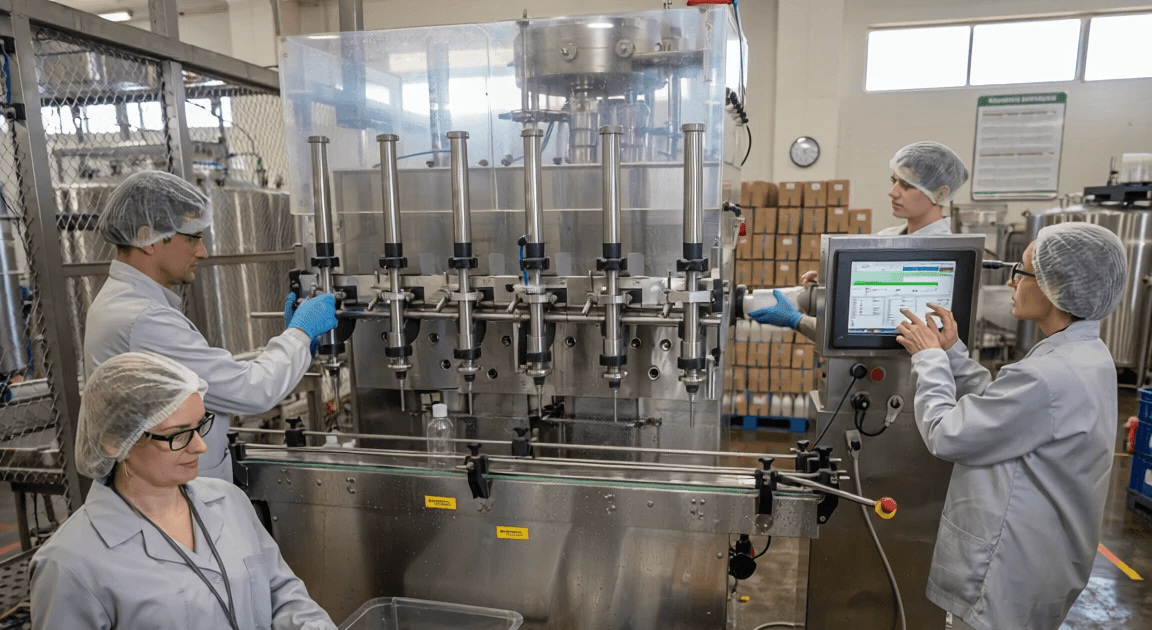


Beauty contract manufacturers should track seven often-ignored workforce metrics: labor cost per unit produced, Overall Labor Effectiveness (OLE), temp-to-permanent conversion rate, shift-level throughput variance, quality defect rate by operator, absenteeism impact on line output, and time-to-productivity for new hires. Together, these metrics directly connect workforce spend to production outcomes and profitability.
Most beauty contract manufacturers have invested in OEE dashboards, MES platforms, and ERP systems that track machines and materials with precision. Yet nearly 80 percent of what goes wrong on a production floor can be attributed to people issues (machinerylubrication.com). That's not a technology gap. That's a workforce visibility gap. Fragmented systems between staffing, production, and finance make it nearly impossible to get a unified view of how labor decisions drive operational outcomes.
Here's why this matters: closing the workforce data gap isn't about adding another dashboard. It's about connecting labor data to production outcomes so every staffing and scheduling decision becomes a business decision backed by evidence.
1. Labor Cost Per Unit Produced
This metric ties your workforce spend directly to production output rather than tracking hours in isolation. Hours worked never equals value produced. A slow line running full shifts inflates labor cost invisibly, and your aggregate payroll data will never surface it.
Calculating labor cost per unit by SKU requires bridging the silo between your payroll or time-tracking system and your production output records. Most ERP and MES systems capture these data points separately, which means most manufacturers are pricing contracts on assumptions rather than actual cost data. That's a margin risk hiding in plain sight.
Seasonal SKU complexity makes this worse. In beauty contract manufacturing, a shift from standard lip gloss fills to small-batch customized serums can swing labor cost per unit significantly without any change in headcount or hours. If you're not tracking labor cost per unit at the SKU level, you're cross-subsidizing your most complex work with your simplest runs and calling it normal.
Why Standard Labor Hour Tracking Misses the Point
Labor hour tracking answers "did people show up?" Labor cost per unit answers "did they create value at an acceptable cost?" These are different questions with very different business implications. Until you can calculate this metric by shift, line, and SKU, workforce optimization is guesswork.
2. Overall Labor Effectiveness (OLE)
OLE is the workforce equivalent of OEE. Where OEE measures machine availability, performance, and quality, OLE applies the same composite logic to your human workforce: Workforce Availability Rate multiplied by Labor Performance Rate multiplied by Quality Rate attributable to labor.
Most beauty contract manufacturers have OEE dashboards. Zero have OLE visibility. That's the blind spot. CPG manufacturers that pursue structured performance improvement achieve an average 12% OEE uplift with an associated 22% productivity improvement across their full sample (rzsoftware.com). The manufacturers achieving those gains are the ones connecting machine data to human performance data simultaneously.
How OLE Differs From Simple Productivity Tracking
Simple productivity tracking measures output per hour. Overall Labor Effectiveness factors in unplanned absences, quality failures, and pace losses in a single composite score. That single number becomes trendable over time and benchmarkable across facilities, shifts, and contract runs. Industry 4.0 frameworks increasingly treat OLE as the missing link between machine data and workforce performance data, and it's the metric our team considers the most underutilized in beauty contract manufacturing today.
3. Shift-Level Throughput Variance
Measuring the output difference between shifts running the same line, same SKU, and same staffing levels is one of the most powerful and underused diagnostic tools in manufacturing. High variance signals a people, process, or supervision issue, not an equipment issue.
Controlling for machine, material, and SKU variables isolates the workforce as the independent variable driving the gap. Shift-level data reveals whether variance is systematic (a consistent underperforming crew) or episodic (a specific event-driven dip). This distinction matters enormously for root cause analysis.
This metric directly supports Kaizen-style continuous improvement by creating a factual baseline. Without it, improvement conversations devolve into opinion. With it, you have a defensible starting point for targeted interventions that don't require capital investment.
Isolating the Human Variable From Equipment Variation
Consider a concrete scenario: two shifts running the same filling line on the same SPF moisturizer SKU, same crew size, same machine settings. One shift consistently outperforms the other. Without shift-level throughput variance data, this gap is invisible. With it, a plant manager can identify whether the delta traces to supervisor behavior, crew composition, or temp labor quality and act accordingly.
4. Time-to-Productivity for New and Temp Hires
This metric measures how many days or shifts it takes a new worker, direct hire or temp, to reach a defined output standard. Beauty contract manufacturing relies heavily on seasonal and temp labor, making this metric especially high-stakes during peak demand windows.
A longer time-to-productivity directly inflates labor cost per unit during onboarding periods. Problems with procedures and training combined are responsible for nearly 40 percent of reliability failures on the production floor (machinerylubrication.com). Low training completion rates compound this: workers who haven't completed role-specific procedures are more likely to cause traceability errors and audit failures under FDA GMP frameworks.
Using Time-to-Productivity to Score Staffing Agency Partners
Tracking time-to-productivity by staffing agency partner reveals which sources actually deliver job-ready talent and which require extensive ramp-up at your expense. Agencies that pre-screen or certify candidates for beauty manufacturing tasks consistently show faster ramp-up. Documenting this metric per agency creates hard leverage in contract negotiations and sourcing decisions, replacing anecdotal impressions with staffing performance data that holds up in a business review.
5. Quality Defect Rate Attributed to Labor
Most quality systems log defects at the line or batch level. That's useful for compliance documentation. It's not useful for workforce optimization. Separating quality failures caused by equipment or materials from those caused by operator error, training gaps, or fatigue requires a layer of attribution that most MES and QMS tools don't provide out of the box.
The stakes in beauty and personal care manufacturing are asymmetric. Equipment is to blame in less than 20 percent of production failures (machinerylubrication.com). Yet most quality investigations start with the machine. Labor-attributed defects in beauty manufacturing carry outsized downstream risk: FDA compliance exposure, brand client chargebacks, and product recalls that damage long-term contract relationships.
Tracking defect rates by operator or crew cohort enables targeted retraining rather than blanket quality audits that consume resources without identifying root causes.
Connecting Labor Quality Data to GMP and Compliance Risk
Beauty contract manufacturers operating under FDA GMP guidelines have both an efficiency incentive and a compliance incentive to track labor-attributed defects. Operator-level quality data supports corrective action documentation required under 21 CFR Part 111 and similar frameworks. Brand clients sourcing from contract manufacturers increasingly request quality-by-workforce data as part of vendor scorecards. Integrated workforce analytics that surface this data aren't just an operational tool. They're a competitive differentiator in client retention.
Tracing poor quality data to its source pays compounding dividends. The 1:10:100 rule in data quality holds that preventing poor data at the source costs a fraction of remediating it after the fact (datakitchen.io). The same logic applies to quality defects: catching operator errors at source is exponentially cheaper than managing recalls or chargebacks downstream.
6. Absenteeism Impact Score (Not Just Absenteeism Rate)
Standard absenteeism rate tells you how often workers miss shifts. Absenteeism Impact Score tells you what it costs in output, overtime spend, and quality degradation when they do. These are two very different numbers.
An absence in a critical line bottleneck position has an outsized operational impact compared to an absence in a buffer role. The standard rate treats both identically. High-turnover beauty manufacturing environments often normalize chronic absenteeism without understanding its compounding effect on OLE and labor cost per unit.
Calculating impact requires connecting attendance data to production output data, a connection most workforce systems don't make automatically. This is the integration gap where workforce intelligence platforms create their clearest ROI.
Building an Absence Coverage Model That Doesn't Inflate Labor Costs
Understanding which roles carry the highest absence impact enables smarter cross-training investment. Real-time absence impact scoring allows operations managers to make coverage decisions before a shift starts rather than reacting mid-line with expensive overtime or undertrained substitutes. High turnover disrupts small-batch customization and personalization demands that define modern beauty contract manufacturing, where a single absent specialist can halt a custom formulation run entirely. Absence impact data also strengthens the business case for retention programs by quantifying the hidden cost of turnover in dollar terms, not just headcount terms.
7. Temp-to-Permanent Conversion Rate and Its Cost Implication
This metric measures what percentage of temp workers convert to permanent roles and how long the average conversion takes. Both dimensions matter.
A low conversion rate signals poor temp-to-culture fit, insufficient evaluation processes, or a fundamental misalignment between your staffing agency partners and your actual long-term talent needs. A high conversion rate achieved too slowly means you're paying agency markup for workers who have already proven their value on your floor. Every week of delayed conversion is a direct cost you could be eliminating.
Tracking conversion rate by agency partner reveals which sources supply viable long-term workforce talent versus which optimize purely for fill-rate volume. Sharing this data with agency partners creates a shared accountability framework rather than a transactional fill-rate relationship. Agencies that understand conversion rate expectations align their candidate screening to your long-term workforce profile.
How Conversion Rate Data Reshapes Your Staffing Agency Relationships
For staffing agencies serving beauty contract manufacturers, proactively tracking and reporting temp-to-perm conversion rates to manufacturing clients is a powerful client retention differentiator. It shifts the conversation from "how many bodies did we place?" to "how many of those placements are still contributing six months later?" That's the framing that wins and retains manufacturing accounts in a commoditized staffing market.
Frequently Asked Questions
What are the most important workforce metrics for beauty contract manufacturers?
The seven most critical metrics are labor cost per unit produced, Overall Labor Effectiveness (OLE), shift-level throughput variance, time-to-productivity for new and temp hires, quality defect rate attributed to labor, absenteeism impact score, and temp-to-permanent conversion rate. Together they connect workforce spend directly to production outcomes, compliance posture, and profitability.
How can tracking workforce metrics improve efficiency in beauty manufacturing?
Workforce metrics surface the specific human variables driving inefficiency: which shifts underperform, which temp sources ramp up slowly, which roles absorb the most absence impact. Acting on that data enables targeted interventions like focused retraining, smarter scheduling, and agency partner optimization that improve production line efficiency without capital investment.
What are some common mistakes beauty contract manufacturers make with workforce metrics?
The most common mistakes are tracking labor hours without connecting them to unit output, measuring absenteeism rate without calculating its production impact, and logging defects at the batch level without attributing them to labor variables. Many manufacturers also evaluate staffing agencies on fill rate alone, ignoring time-to-productivity and temp-to-perm conversion as performance indicators.
How do workforce metrics differ between small and large beauty manufacturing companies?
Smaller manufacturers typically have fewer data systems but higher SKU complexity relative to headcount, making labor cost per unit and time-to-productivity especially critical metrics. Larger operations running multiple shifts across multiple facilities gain the most from OLE benchmarking and shift-level throughput variance tracking, where cross-facility comparisons reveal systemic versus local performance gaps.
What tools or software are best for tracking workforce metrics in the beauty industry?
Effective workforce intelligence requires integrating data from time-and-attendance systems, MES or production tracking platforms, and payroll or ERP systems. Dedicated workforce analytics platforms like Elements Connect bridge these silos without replacing existing systems. The key capability is connecting labor input data to production output data in real time, which standalone QMS or ERP systems rarely do natively.
What is Overall Labor Effectiveness (OLE) and how does it differ from OEE in beauty contract manufacturing?
OLE applies the same composite logic as OEE to the human workforce: availability rate multiplied by performance rate multiplied by labor-attributed quality rate. OEE measures machine performance. OLE measures workforce performance. Most beauty contract manufacturers have OEE visibility and zero OLE visibility, creating a critical blind spot in operational intelligence for their highest cost variable.
How do you calculate labor cost per unit produced when your ERP and production systems are disconnected?
Calculating labor cost per unit requires bridging three data sources: total labor cost per shift from payroll or time-tracking, units produced per shift from your MES or production records, and SKU-level attribution where multiple products run per shift. Workforce intelligence platforms accomplish this integration without requiring full ERP replacement, delivering the metric even from siloed source systems.
Which workforce metrics matter most for evaluating staffing agency performance in contract manufacturing?
The three most defensible agency performance metrics are time-to-productivity (how quickly their workers reach output standard), temp-to-permanent conversion rate (how many placements become viable long-term employees), and labor-attributed defect rate by agency cohort. These metrics replace anecdotal performance impressions with hard staffing performance data that supports objective contract negotiations and sourcing decisions.